What does IRC M1502.4.1 require?
The duct is smooth-interior metal, at least 0.0157 in. thick (No. 28 gage), and 4 in. nominal.
Smooth-wall rigid metal for the run through the house. Flexible duct stays the short connector behind the dryer.
Flexible foil or vinyl duct is only meant to be the short transition right behind the dryer. Any run through a wall, ceiling, attic, or crawlspace should be smooth-wall rigid metal. Soot Soldiers replaces it. The same visit can cover a crushed transition, a disconnected duct, a broken or stuck wall or roof cap, or a bird nest. Service covers Lackawanna County, the Scranton area, Hawley, Milford, Pocono Lake, and Hazleton, with no travel fee.
That flexible duct is only meant to be the short, visible connector behind the dryer. Hidden flex duct sags, gets crushed, and holds lint where you cannot see it. Dust, fiber, or lint was the item first ignited in 27% of home dryer fires in the NFPA 2014–2018 report cited below.
Soot Soldiers does dryer vent replacement across NE PA and the Poconos. If the line only needs a cleaning, that work is on the dryer vent cleaning page.

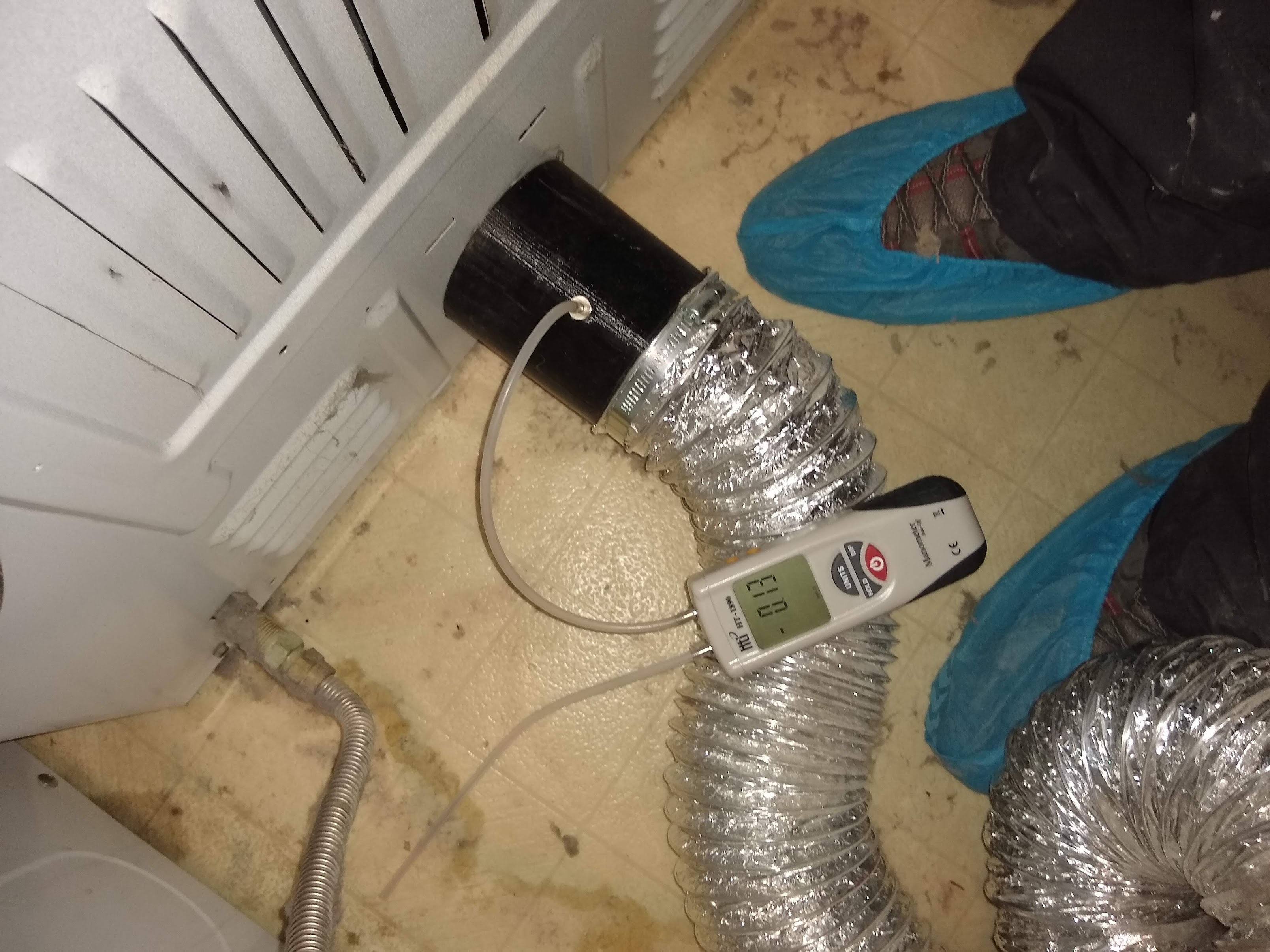
In Pennsylvania, new and permitted dryer vent work follows the 2021 International Residential Code, adopted in the PA Uniform Construction Code as of January 1, 2026. The code allows flexible duct only as the connector behind the dryer. It has to be a single listed transition duct (UL 2158A), 8 ft or shorter, and never hidden in a wall, ceiling, or floor. The run through the house has to be smooth-wall metal, 4 inches, with sealed joints and no screws sticking in more than 1/8 in. It is limited to 35 ft minus allowances for elbows, unless the dryer maker allows more, and it must end outdoors with a backdraft damper and no screen. Dryer makers' instructions are often stricter.
The code applies to new or permitted work. It is not retroactive. If an existing vent does not match, it doesn't meet current code or the dryer maker's instructions. Soot Soldiers can look at the run and tell you what you have.
The duct is smooth-interior metal, at least 0.0157 in. thick (No. 28 gage), and 4 in. nominal.
Support the duct at least every 12 ft. Point the male end in the direction of airflow. Seal the joints (M1601.4.1) and fasten them mechanically. Screws and fasteners may not protrude more than 1/8 in. into the duct. The wall or ceiling cavity must fit the duct without deforming it.
The transition duct is a single length, listed and labeled to UL 2158A, 8 ft maximum, and not concealed within construction. UL 2158A covers the piece that connects the dryer to the permanent duct in the building. Those ducts are typically foil or semi-rigid aluminum. A listed foil transition can be code-legal behind the dryer. Vinyl or plastic is never listed for this.
The limit is 35 ft from the transition connection to the outside terminal, minus the fitting allowances in Table M1502.4.6.1, or the length in the dryer manufacturer's instructions. The transition duct is not counted. A 4 in. radius mitered 90° counts as 5 ft. A 6 in. radius smooth 90° counts as 1 ft 9 in. A listed power ventilator's instructions are a third option (M1502.4.6.3). Booster fans are prohibited (M1502.4.4 and M1502.4.5). If the equivalent length is over 35 ft, M1502.4.7 requires a permanent label within 6 ft of the connection.
In the 2018 IRC, Pennsylvania's prior code effective February 14, 2022, the length section was M1502.4.5. Use the 2021 numbers for current work.
Terminate outside, 3 ft from openings into the building, including ventilated soffits. A backdraft damper is required. No screens.
Dryer venting in a home is mainly an IRC or IMC matter. NFPA 54, the National Fuel Gas Code, 2024 edition with TIA 24-1, covers gas dryers. Section 10.4.5.3 says Type 1 dryer exhaust ducts "shall be constructed of rigid metallic material." Section 10.4.5.4 says transition ducts must be listed to UL 2158A and installed per the dryer manufacturer.
Do not connect a dryer exhaust to a vent, gas vent, or chimney. That rule comes from IMC 504.4, NFPA 54, and dryer manufacturer instructions. NFPA 211 covers chimneys, fireplaces, vents, and solid-fuel appliances. It is not the code for dryer ducts.
Buildings under the International Mechanical Code follow 2021 IMC Section 504, which also calls for smooth-wall metal, a single UL 2158A transition of 8 ft or less that is not concealed, outdoor termination with a backdraft damper and no screens, and a 35 ft limit or the manufacturer's limit. Booster fans are prohibited there too.
Manufacturer instructions are often stricter than the code. Whirlpool install instructions W11691479 say: "Do not install a clothes dryer with flexible plastic venting materials or flexible metal (foil type) duct." They also say: "Only a 4" heavy metal exhaust vent and clamps may be used." Flexible metal is allowed only where it stays accessible, never "in enclosed walls, ceilings, or floors," with a total of 7¾ ft or less. Exhaust must not connect "into any gas vent, chimney, wall, ceiling, attic, crawlspace, or a concealed space." The same instructions say: "Replace plastic or metal foil vents with rigid metal or flexible metal vents."
GE install instructions 31-3000199 say: "Use only 4" rigid metal ducting for the home exhaust duct." They also say: "DO NOT use any plastic to vent the dryer." And: "DO NOT use flexible metal or metal foil ducting for a home exhaust duct." A UL-listed transition is limited to this: "Never install transition duct in walls, ceilings, floors or other enclosed spaces," with a total of 8 ft or less. GE says: "Remove and discard existing plastic or metal foil duct and replace with UL listed duct."
Other brands vary. Some, for example LG and Kenmore, allow a UL 2158A foil transition. Others, including Whirlpool, Maytag, Amana, and Electrolux, do not. Check the manual for the dryer in the house.
The code applies to new or permitted work. It is not retroactive. A listed transition of 8 ft or less, left visible behind the dryer, is allowed by the code. Some manufacturers still prohibit foil in that spot.
If the vent in the house does not match these rules, say it doesn't meet current code or the dryer maker's instructions. Then replace the hidden foil or vinyl with smooth-wall rigid metal, and keep any flexible piece as the short connector behind the dryer.
Not every dryer vent problem needs a whole new run. These are common repairs:
Every one of these chokes airflow, so clothes take longer to dry and lint builds up. Soot Soldiers finds the problem and fixes it. If part of the run is foil or vinyl where it should not be, that part is replaced with rigid metal.
If anything looks off, Soot Soldiers can clean it, repair it, or replace it with rigid metal duct. Full-run cleaning is described on the dryer vent cleaning page.
NFPA, "Home Fires Involving Clothes Dryers and Washing Machines" (2014–2018 annual averages): about 13,820 home dryer fires a year, 7 deaths, 344 injuries, about 233 million dollars in direct property damage. Failure to clean was the leading factor (32%). Dust, fiber, or lint was the item first ignited in 27%.
USFA Topical Fire Report Vol. 13, Issue 7 (2008–2010): about 2,900 residential clothes dryer fires a year, 5 deaths, 100 injuries, about 35 million dollars in property loss. Failure to clean was the leading factor (34%). Fires peak in fall and winter, highest in January (11%).
The two reports cover different years and use different estimating methods, so the counts differ.
Sources: https://content.nfpa.org/-/media/Project/Storefront/Catalog/Files/Research/NFPA-Research/US-Fire-Problem/osdryer.pdf and https://www.usfa.fema.gov/downloads/pdf/statistics/v13i7.pdf.
Already booking a chimney sweep? Add a dryer vent cleaning to the same visit. One trip, both jobs done. While on site, Soot Soldiers checks whether the dryer duct is the right material for where it runs.
Home dryer fires peak in the fall and winter, and January is the highest month, according to the U.S. Fire Administration report above.
Yes. Guests run the dryer constantly, and lint builds up fast. A yearly vent cleaning, plus swapping any hidden foil for rigid metal, is one of the easiest safety wins. Book all of a property's dryer vents in the same visit.
Soot Soldiers serves Lackawanna County, the Scranton area, Hawley, Milford, Pocono Lake, and Hazleton, with no travel fee. Hours are Monday through Friday, 8:00 AM to 5:00 PM. Call 570-483-9730 to schedule, or book online. Email contact@sootsoldiers.com.
Soot Soldiers is a service-area business. There is no street address on this site.
Flexible foil or vinyl duct is only meant to be the short transition right behind the dryer. Any run through a wall, ceiling, attic, or crawlspace should be smooth-wall rigid metal. Soot Soldiers replaces it.
Pennsylvania adopted the 2021 International Residential Code, effective January 1, 2026, in the PA Uniform Construction Code. The code applies to new or permitted work. It is not retroactive. An existing vent that does not match doesn't meet current code or the dryer maker's instructions.
The duct is smooth-interior metal, at least 0.0157 in. thick (No. 28 gage), and 4 in. nominal.
Support the duct at least every 12 feet. Point the male end in the direction of airflow. Seal the joints and fasten them mechanically. Screws and fasteners may not protrude more than 1/8 in. into the duct. The wall or ceiling cavity must fit the duct without deforming it.
The transition duct is one length, listed and labeled to UL 2158A, 8 feet maximum, and not concealed in a wall, ceiling, or floor. A listed foil transition can be code-legal behind the dryer. Vinyl or plastic is not listed for this. Some dryer makers prohibit foil even there.
The limit is 35 feet from the transition connection to the outside terminal, minus an allowance for each fitting, or the length in the dryer manufacturer's instructions. The transition duct is not counted. A 4 in. radius mitered 90° counts as 5 feet. A 6 in. radius smooth 90° counts as 1 foot 9 inches.
It terminates outdoors, at least 3 feet from openings into the building, including ventilated soffits, with a backdraft damper and no screen.
NFPA 54 covers gas dryers. Section 10.4.5.3 says Type 1 dryer exhaust ducts shall be constructed of rigid metallic material. Section 10.4.5.4 says transition ducts must be listed to UL 2158A and installed per the dryer manufacturer. NFPA 211 covers chimneys, fireplaces, vents, and solid-fuel appliances. It is not the code for dryer ducts.
Whirlpool instructions W11691479 say: "Do not install a clothes dryer with flexible plastic venting materials or flexible metal (foil type) duct." They also say: "Only a 4" heavy metal exhaust vent and clamps may be used." GE instructions 31-3000199 say: "Use only 4" rigid metal ducting for the home exhaust duct." They also say: "DO NOT use any plastic to vent the dryer" and "DO NOT use flexible metal or metal foil ducting for a home exhaust duct."
Common repairs are a crushed connector behind the dryer, a duct that came apart inside a wall or ceiling, a broken or stuck wall or roof cap, and a bird nest blocking the outside vent. If part of the run is foil or vinyl where it should not be, that section is replaced with rigid metal.
Clothes take more than one cycle to dry. The dryer or laundry room gets hot. There is a burning or lint smell. The outside flap barely opens, or lint shows up around the cap. The connector behind the dryer may be crushed, kinked, or plastic.
NFPA, "Home Fires Involving Clothes Dryers and Washing Machines" (2014–2018 annual averages): about 13,820 home dryer fires a year, 7 deaths, 344 injuries, about 233 million dollars in direct property damage. Failure to clean was the leading factor (32%). Dust, fiber, or lint was the item first ignited in 27%. Source: https://content.nfpa.org/-/media/Project/Storefront/Catalog/Files/Research/NFPA-Research/US-Fire-Problem/osdryer.pdf. USFA Topical Fire Report Vol. 13, Issue 7 (2008–2010): about 2,900 residential clothes dryer fires a year, 5 deaths, 100 injuries, about 35 million dollars in property loss. Failure to clean was the leading factor (34%). Fires peak in fall and winter, highest in January (11%). Source: https://www.usfa.fema.gov/downloads/pdf/statistics/v13i7.pdf. The two reports cover different years and use different estimating methods, so the counts differ.
Yes. Add a dryer vent cleaning to a chimney sweep visit so both jobs are done in one trip. While on site, Soot Soldiers checks whether the dryer duct is the right material for where it runs.
Yes. Guests run the dryer constantly, and lint builds up fast. A yearly vent cleaning, plus swapping any hidden foil for rigid metal, is one of the easiest safety wins. Book all of a property's dryer vents in the same visit.
Soot Soldiers serves Lackawanna County, the Scranton area, Hawley, Milford, Pocono Lake, and Hazleton, with no travel fee. Hours are Monday through Friday, 8 AM to 5 PM. Call 570-483-9730 to schedule, or book online. Email contact@sootsoldiers.com. There is no street address.